
Why AI-generated proposals are not enough


Why AI-generated proposals are not enough
AI has made writing tender proposals a lot easier. Perhaps even a little too easy. Open any generic AI tool such as ChatGPT, Gemini or Copilot and within moments you’ll have a well-written introduction, a few solid arguments and a perfectly average conclusion. And that speed is exactly where the problem begins.
Because if you can produce a tender answer in no time, so can your competitors. When everyone has access to the same generic AI tools, speed is no longer what sets your proposal apart. The real difference lies in what the AI knows about your organisation, this particular tender and everything your team has already uncovered along the way. In this article, we explore the difference between generic and tender-specific AI, and why the latter can give you a much stronger chance of winning.
A strong answer starts with the right context
Give AI the question, some background information and your preferred tone of voice, and within seconds you’ll have a usable first draft. But tenders aren’t won on flawless sentence structure alone. A strong proposal needs to show that you understand what the buyer is asking for, that you meet the requirements and that your organisation can genuinely deliver on the promises you make. To do that, you also need information from across your organisation, including knowledge from all those previous tender proposals.
And that’s where generic AI reaches its limits. A tool such as ChatGPT, Gemini or Copilot can do an enormous amount with the information you provide. But you are still the one who has to collect that information and feed it into the platform first. In practice, that often means your prompt gets longer and longer. The tender question, the relevant requirement, information about your services, a previous case, a clarification from the Q&A: the more context you provide, the more specific the answer becomes. For an individual task, that works perfectly well.
Working faster doesn’t automatically mean working smarter together
Across an entire tender process, things become more complicated. Requirements, risks, clarifications and previous content are often spread across different documents and systems. When every specialist works in their own generic AI chat, the prompts, sources and outputs remain scattered too.
Sure, the individual tasks get done faster. But at team level, some of that time saving — and some of the knowledge — is lost again further down the line. Outputs still need to be checked, different analyses compared and relevant information brought back together. And the moment a requirement changes or new information comes in, that entire review cycle starts all over again.
Tender-specific AI builds on what you already know
With an AI tool built specifically for tender processes, things work differently. Instead of treating every new question as a standalone writing task, the output builds on information that has already been gathered throughout the process. Requirements, risks, clarifications, source references and knowledge from previous tenders all remain part of the same context.
That also means you don’t have to work out which documents, cases or previous answers are relevant every time you write a new prompt. The information your team has already gathered remains available when you need it. And because everyone works from the same environment, knowledge from previous proposals doesn’t end up locked away with one person or buried in an isolated chat. So every tender doesn’t just make the individual writer smarter — the entire team builds on what it has already learned.
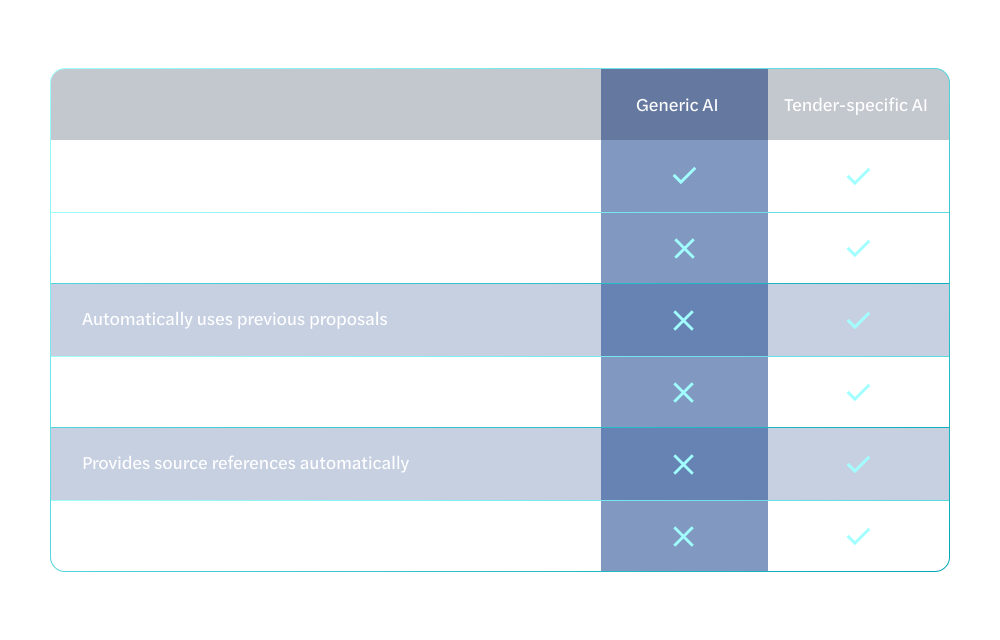
Generic AI vs. tender-specific AI
We could spend hours talking about the difference between generic and tender-specific AI, but we could also just show you. Because the difference becomes much clearer when you give both tools exactly the same task.
So we take one tender question and compare the answers side by side. For the generic AI tool, we use exactly the same question as we do for Brainial. The only difference is the context each tool can draw from.
Question: xxx
Answer from ChatGPT/Copilot/Gemini: xxx
Answer from Brainial: xxx
One helps you write, one helps you win
Generic AI is perfect for getting to a first draft quickly. But a strong, well-supported tender response requires more than good wording. You want to know that the right context, sources, clarifications and previous knowledge have all been taken into account.
That’s where a tool like Brainial comes in. Built specifically for the complete bid cycle, Brainial connects requirements, risks, source references, clarifications and knowledge from previous proposals in one environment. So you don’t just work faster — every answer builds on information that already exists within your tender process.
Curious to see how it works? We’d be happy to show you in a demo.
.png)


